
Have you recently been asked to on-board a Distributor like Ingram Micro, Dicker Data, Pax8 or Crayon by your current Azure Cloud Solution Provider?
It might have been a result of Microsoft overhauling its Cloud Solution Provider (CSP) program requirements and your CSP has met the changes. For years, being a Direct (Tier 1) partner was little more than ticking a few boxes and hitting a modest revenue threshold. That changed in October 2025. Now, only the most capable, security-focused partners make the cut.
Here’s what’s new:
- The annual revenue threshold jumped to $1 million, a 70% increase.
- Partners must hold a Solutions Partner designation, independently audited by ISSI, a leading global audit and certification company.
- Security is front and centre; partners must respond to Azure security alerts within 24 hours and enforce MFA for privileged support teams.
If you’re a customer, this isn’t just marketing fluff. Microsoft wants you working with partners who know their stuff and can keep your cloud secure.
Why Choose a Direct (Tier 1) CSP?
1. The “Fast Lane” to Microsoft Support
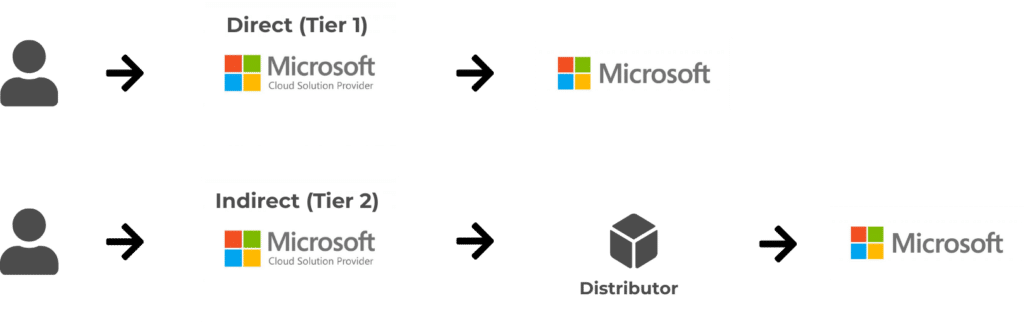
In the Indirect Tier 2 model, the support process looks like: you call your reseller, they call their distributor, and the distributor calls Microsoft. That means delays, confusion, and frustration, especially when your Azure environment is down and every minute counts.
The Direct CSP Advantage:
Tier 1 partners have a direct line to Microsoft. Aligned to the 2025 rules, Microsoft have refreshed the new CSP Support programs to ensure you have the best means of escalation for when something breaks. Microsoft’s new approach is about scaling support through partners who are close to your environment and can get to the root cause quickly. No more waiting in line behind a chain of intermediaries.
2. Verified Technical Bench Strength
You can’t just stumble into Tier 1 status anymore. To meet Microsoft’s new mandates, a Direct CSP must prove deep expertise across specific solution areas, Azure Infrastructure, Data & AI, DevOps, and more.
The Direct CSP Advantage:
You’re not just getting a vendor who clips the ticket and sends you a bill; you’re getting a team that’s been independently audited for technical competency. You should expect support across assessment, design, migration, and ongoing management of your Azure environment. Plus, Direct partners get access to Microsoft Accelerate which that can help reduce your migration costs and accelerate your cloud journey. At Codify, we’ve built our own IP around proactive governance (to keep you in a well-architected state) and a FinOps platform (so you don’t get bill shock), made possible by integrations only available to Direct bill partners.
3. Streamlined Accountability & Supply Chain (Single Point of Contact)
Vendor sprawl is a headache for CIOs and IT Operations. When something goes wrong, who do you call? Who’s actually responsible?
The Direct CSP Advantage:
A Tier 1 partner owns the entire lifecycle; licensing, technical architecture, implementation, and monthly billing. If there’s a discrepancy or a failure, there’s “one throat to choke”. You get visibility of the supply chain, which can be diluted with an Indirect CSP (whose distributor is likely a global organisation). The benefits of a local provider are lost when you’re dealing with multiple layers. Microsoft can’t manage every customer directly, so it’s fostered a partner network that’s built for relationships and understanding your business. Our investment as a Direct CSP means you don’t need to extend your supply chain further than you’re comfortable with.
4. Enhanced Security and Governance
Security is no longer optional. Direct partners are held to a higher standard of operational hygiene and must respond to security alerts within 24 hours for customer cloud environments.
The Direct CSP Advantage:
Direct partners are better equipped to help you navigate complex compliance frameworks (like ISO, NIST, or E8) because their own infrastructure must meet those same rigorous standards. Microsoft recognises that customers have their own preferred frameworks and processes. A Direct CSP not only handles security alerts but, through our Managed Service, we integrate with your own SOC team and processes.
Direct vs. Indirect CSP: At a Glance
| Feature | Direct (Tier 1) | Indirect (Tier 2) |
| Microsoft Relationship | Direct Contract | Via a Distributor (I.e. Ingram Micro, Dicker Data, Pax8) |
| Minimum Revenue | $1M+ (High Stability) | No/Low Minimum |
| Support Path | Direct Escalation | Multi-step Escalation |
| Best For | Enterprises & Scaling Orgs | SMBs & Simple Environments |
| Technical Depth | Verified “Solutions Partner” | Varies by Provider and may involve Distributor |
If your organisation is growing, has complex security needs, or relies on Azure for mission-critical operations, the Direct (Tier 1) model is designed to provide the stability and expertise you require.
Do you need support with a Request for Information (RFI) template that you can send to your existing partners to understand if they meet these 2025 Direct Tier 1 requirements? Get In Touch with Codify’s Microsoft Azure Specialists
Related Blogs:
The Shift from Microsoft EA to CSP: What It Means for Your Business – Codify
See How Your Azure Costs Compare: 2025 Benchmark Insights – Codify
Your Azure Project Just Got a Major Co-Investment from Microsoft – Codify